
Saltburn Sucks
Suck as it may, it looks damn good all the same.

To be honest, I did not dislike Saltburn upon first viewing. I was very much caught up with potential ideas and themes of class and lookism, thought the presentation, cinematography, and colour grading were phenomenal, and was generally enthralled by all of the acting on display; most of all though from Jacob Elordi, for whom it was my debut viewing.
To be frank, I am a little embarrassed to admit that I was taken so aback by these elements of the film that, while I will continue to sing their praises, I did not at first realise the shallow nature of what I was seeing.
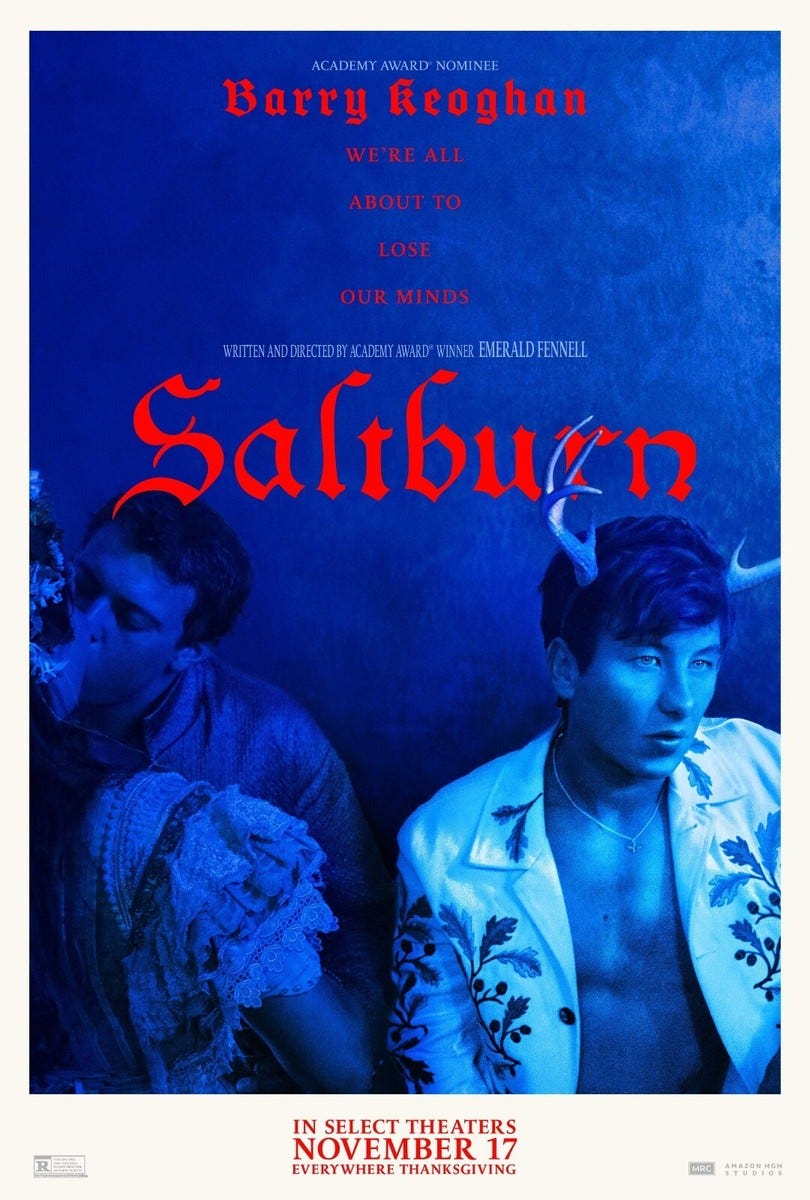
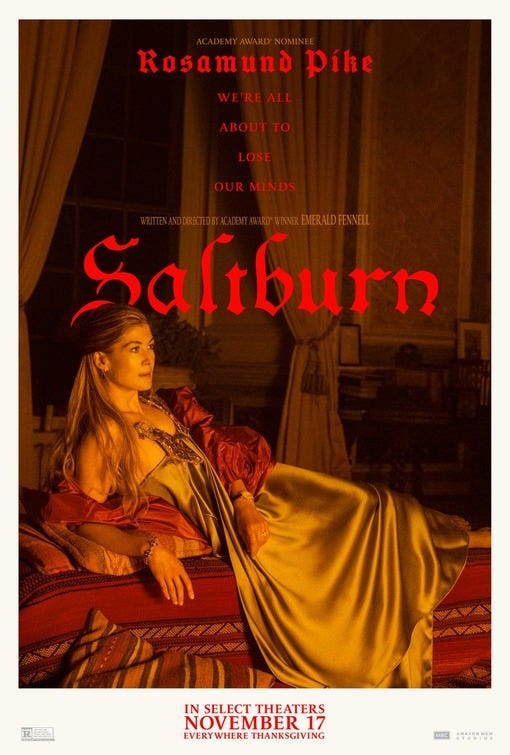
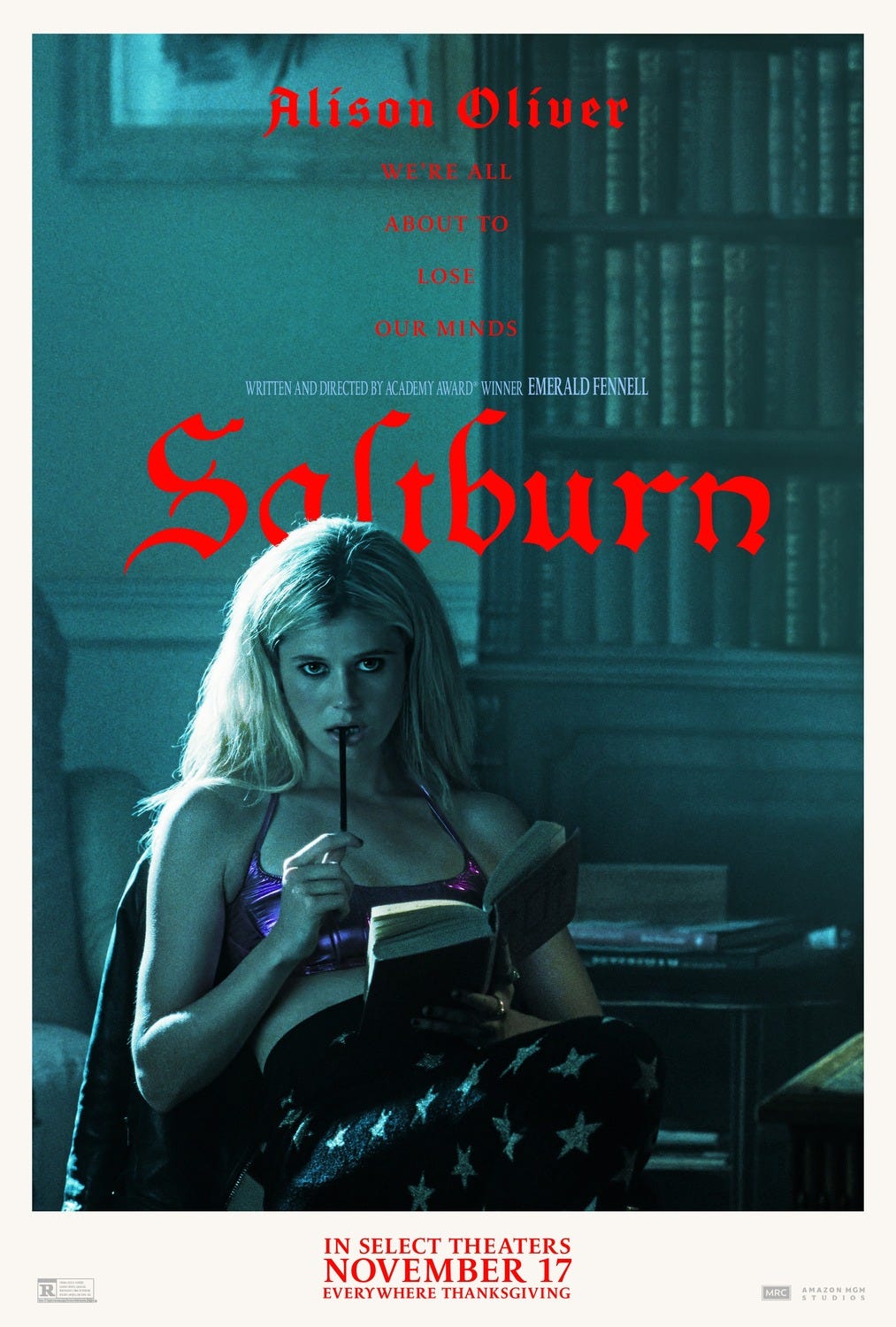
I will say also that these posters are magnificent.
Now that we are past the introduction and the, hopefully, clickbait title, I can say that I do not think “sucks” is really the best word to describe the film and that I did enjoy my time with it. I imagine I would, too, enjoy a second viewing, however the film simply leaves a lot to be desired, especially with all of the imagery that is sewn throughout.
I immediately took the film to be about class and lookism, ideas about how easy things can be for those that are handed the genetic and societal silver spoon such that their flourishing becomes more an obvious facet of their being and nature as a person rather than something that was worked at and achieved in the face of adversity. It is evident that Oliver is a fine young man, has gotten into a good university, and generally overcome his background of growing up in a potentially abusive and most definitely insufficient household when it comes to his care and nurturing. However, despite that, he has no friends and becomes stuck with someone in a similar place to him. Someone that, seemingly through no fault of their own, just lucked out of the genetic lottery and was instead endowed with beauty that does not match that of the social standard and a personality that has gone unadjusted so as not to fit with those same norms.
And then we have Felix. Someone who, might I add, has likely worked hard for where he is but at the same time is someone that we can realise has had a much easier and more direct time than Oliver. He has the looks, conforms to the social standards, gets all of the girls and could most definitely get the boys too if he wanted, has money, a place to go back to, seemingly loving parents, and the same education that Oliver is getting.
It may seem somewhat unfair to put down Felix while giving praise to Oliver, but it is an unfortunate fact of the society we live in that some just do have it easier than others through no work or fault of their own. By default, those people are expected to do better. We expect Felix to get into university, pass with flying colours, get a high-paid job, get a partner that matches his high socioeconomic status and is as beautiful as he, while with Oliver… we say “well done, mate.” Nothing is expected of Oliver and he is not granted the same status if he rises to where Felix is, only a maybe well-meaning but then again maybe not slight approval or congratulatory statement.
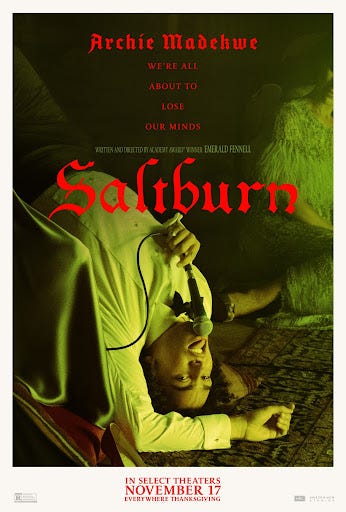
We see this theming directly mentioned in the film, mainly at the beginning but also a little at the end, more or less solely from Farleigh. He comments and implies that Oliver does not belong, will not be able to stay and is just getting a taste of what he was never born to and can therefore never have, essentially telling him he is playing pretend— you could look into this as foreshadowing for a later plot development but, we’ll get to that.
It saddens me to say that the film does not seem to have a thesis on these ideas, although it seems painfully obvious to me that we are not meant to like Farleigh. He is seemingly the same as Oliver in that he is not by birth a part of high society, although I am unsure if he is meant to be a parallel to Oliver. I think you could see him in that way given he is a very direct suck-up to Felix and his family, not wanting to upset that order that he has gotten himself into. He needs them and seemingly subsists on them both financially and socially in regard to his status; his status being that he is a friend of Felix, a family friend. It is not clear where Farleigh comes from, but he asks Felix for help financially at some point and is mocked by Felix and his sister, Venetia, for needing to go to their parents for help. It would therefore also be rather obvious that all of his comments towards Oliver are likely projection on his part.
This could be an interesting parallel in that we see two sides of the same coin when someone of a lower class befriends or is befriended by someone from high society. I feel this is also alluded at when we see Oliver push back against Felix at parts in the film, he is still his own person, independent of Felix and can thus challenge him whereas Farleigh is not, cannot.
But the film does not really punish or call Farleigh out for these things. He is shunned by the end of the film, but this is due to the plot development that tears down all of the above.
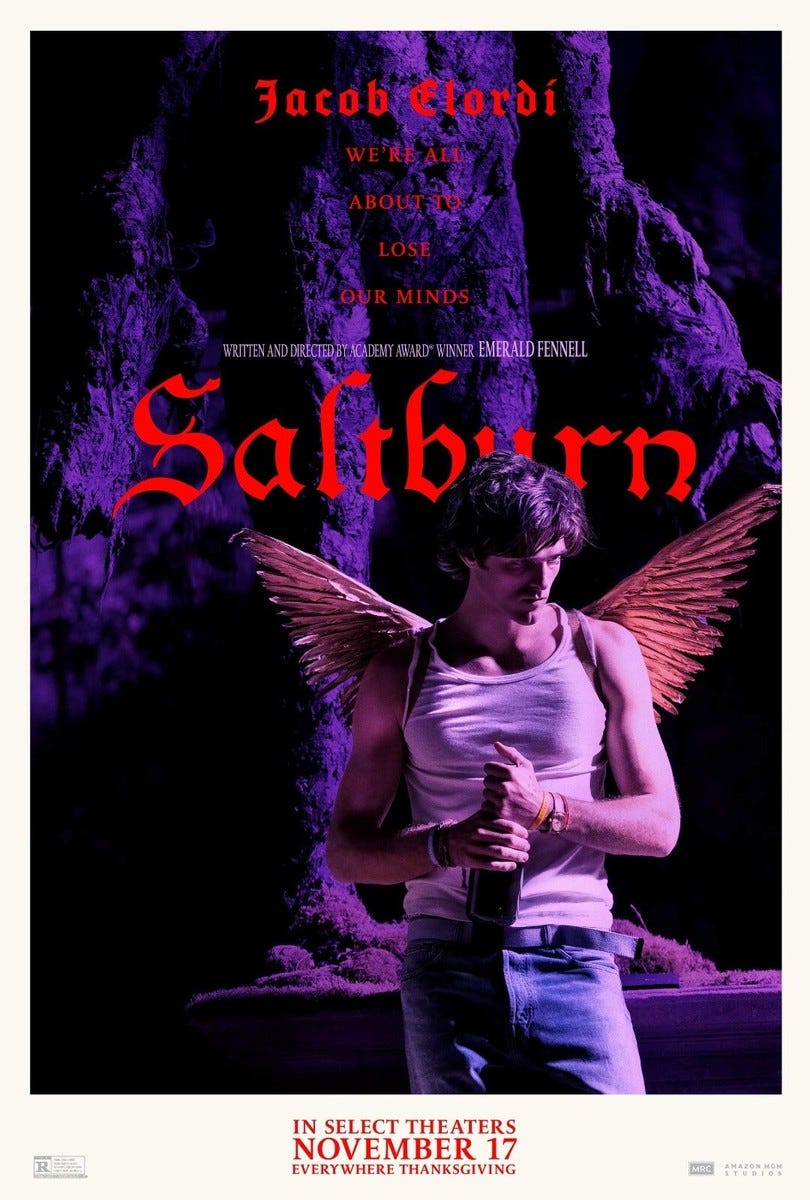
Turns out, Oliver is fucking evil.
After Oliver is taken into Saltburn for the summer, he begins to manipulate and turn on each member of the Catton family. At first, I thought this was an interesting subversion. I felt that this film clearly thematically fits with the likes of Midsommar and Get Out wherein an outsider is brought into the secluded home of a group that seems normal on the outside but is actually wildly horrific on the inside, and so here we have a horrific outsider who seems normal being brought into an otherwise benign albeit wildly wealthy family. But I really don’t think the film was going for that, maybe it was and maybe it is an interesting personal takeaway that I can use to enjoy it more but there is so much elsewhere that just makes me wish the text had something to say.
Take the scene wherein Oliver is in the bathtub, this is a scene after Oliver has just had a sexual encounter with Venetia, the blood around his lips being from the fact she was menstruating. What is this supposed to say in the context of this film?
It’s quite a vivid image, as is the use of menstrual blood in of itself. However, the use of menstrual blood typically symbolises things like motherhood and childbirth; the role of women in society and their relegation to these roles without choice, the subjugation by the men and society at large which force them into these roles without consideration of the potential trauma or aftereffects. To my knowledge, I would say it is less-so used to comment on the sexual conquest of women by men, but it could be. Blood being obviously symbolic of violence and menstrual blood both specifically being blood and something inherently linked to women and their sex. So is this scene telling us that Oliver is conquering Venetia, using her without much thought for his own sexual gratification as men and society have done for years? If I think that, then the next step would be to link it to further images or dialogue in the film to cement the point and then analyse the thesis; but there is no further text I can link this analysis to. I don’t even think what I just said was text, it’s my own analysis and unpacking of an image that I don’t think has anything to say.
There are two other scenes that come to mind as I make this point, two vivid and rather superficially poignant scenes: the (first) bathtub scene and the grave scene.
The bathtub scene involves Oliver peeping on Felix in the bathtub and seeing him masturbate. Once finished, he gets out, leaves, and Oliver enters the room. He climbs into the bathtub and quite literally laps at the semen-infused bathwater surrounding the plughole. In a vacuum, I can understand this scene as of course being potently about homosexuality, but the scene does not give me feelings of love. It feels more stalker-ish, it feels not like basking in the aura of someone you feel so deeply for but more-so trying to desperately ingest the raw sex of someone you crave, it’s perverted in a very clear way; disgusting not in a gross way, but in that it does not feel like the kind of thing someone would do to someone they respect or cherish.
The grave scene is easier to tie to themes of love, I think. It happens after Felix’s death, after the funeral, Oliver is at his grave, crying. He lowers himself down and lies on top of the soil with music in the background. He then begins undressing, until fully nude, and then begins having sex with the grave, inserting himself into the soil. This scene feels more like an emotional outpouring, a desperate and last-ditch effort to express unexpressed feelings of love toward someone that is now gone in the most final way someone can be. I was genuinely so impressed upon first viewing, it felt so emotionally raw in a way that I personally have not seen many films do; the way it held the still shot, took away the music, and the acting on display, it all came together perfectly. I could say that together, these scenes are trying to convey ideas of homophobia in society, that love between two gay men, or rather the unrequited love of one gay man, is being reduced to this due to the society in-which they live, that Oliver is unable to express himself as he should be able to do and so is instead forced to do so in these ways, reducing himself and his love to shame.
But does the film contain themes or other images that share those ideas? If my unpacking of those scenes has merit, then what is the film trying to say? Where is the thesis? To me, there isn’t one. These scenes exist poignantly only in a vacuum while as a whole they just don’t fit together. Plus, you know, or maybe you don’t but, Oliver murdered Felix. So why is he so distraught?
At the end of the film, Oliver dances around the Catton home after murdering them one-by-one, including Felix, the man he seemingly lusted over and became incredibly distraught, somehow, by the death of. Note also that the themes I just unpacked from those scenes have nothing to do with the earlier themes I discussed, themes that the film is clearly outlining at the time.
That is my main issue with the film, I think that in solitude there are many scenes that have something clear to say, but that the film does not come together as a whole. It does not have a thesis, it does not synthesise the ideas it has. Not that I can see, anyway. Unfortunately, this is the final thought that I come away with. That this film has nothing to say, has no coherent vision, it just looks nice. It really does, the film is expertly shot and acted but that veneer is not enough come the end of the film.
As soon as the twist takes hold, as soon as Oliver reveals his true intentions and the film has a montage of his villainy— which is that he has been planning this the whole time, from the very first scene and meeting of Felix and Oliver, he planned to get into the home and murder them such that he can take over the estate— I knew. I felt it in my stomach, I felt the despondency of a film that could have had so much to say but ended up saying nothing.
Your take is your take, but you fundamentally mistook many things in the film. For one, Farleigh is not the same as Oliver, Farleigh is not some "family friend", he was indeed born into it - his mother is Sir James' sister, Felix's aunt. Farleigh is being financially cared for because Farleigh's mother blew through money, so Sir James' took control.
Oliver wasn't going down on a menstruating Venetia for his own sexual gratification. Elspeth told him how Venetia had an eating disorder. What better way to curry favor from Venetia than for Oliver to use their mutual attraction to show her that he's not put off by her and accepts her body completely, down to what her body does.
And while Oliver had a plan all along to get close to Felix, he did not plan on killing half the family and taking over Saltburn. Even Emerald Fennell said Oliver's dream would be to be married to Felix and living in Saltburn with him, but as that was impossible, so him proceeding to go through the family was the "best of a bad bunch of options". She called it a "love story that never happened". Oliver was in love with Felix but was worried he'd be discarded as easily as Pamela was, so he had to get Farleigh ousted and curry favor within the house.
His actions were cascading -every decision Oliver made that led to him getting Saltburn was because he was trying to stay in Felix and the Catton's orbit.